

Contact Information
Research
 How Are Active Region Properties and Heating Connected?
The timescale on which coronal plasma is re-energized is a crucial diagnostic of the heating mechanism. Any mechanism must reproduce the full distribution of the properties of key observables (e.g. emission measure and time-lag maps), which have been shown to be highly correlated with the rate of re-energization per flux tube (heating frequency). Previous studies have combined hydrodynamic modeling with sophisticated forward modeling and machine learning to predict the frequency of heating events in an active region from multi-temperature imaging observations and derived observables. It was found that high-frequency heating dominates the active region core, while the periphery was consistent with lower frequency heating. We extend earlier investigations to a larger sample including newly emerged, mature, and decaying active regions, and during different stages of the solar activity cycle. We also follow active regions as they traverse the solar disk to study how their heating properties change and evolve with age. The Goal of this investigation is to determine the physical nature of heating in solar active regions. We answer two Science Questions: 1. What is the temporal and active-region-to-active-region variation in heating frequency? 2. How is the variability of the heating frequency in an active region connected to its magnetic properties?
Related Publications
- Understanding Heating in Active Region Cores through Machine Learning. II. Classifying Observations
- Understanding Heating in Active Region Cores through Machine Learning. I. Numerical Modeling and Predicted Observables
 Probing Flare-Generated Slow-Mode Waves in Coronal Loops Detected by SDO/AIA
Recent high-resolution and high-cadence EUV observations of MHD waves have allowed rapid development of a technique called Coronal Seismology (CS), which can be used to determine physical parameters of coronal structures that cannot be directly or easily measured. SDO/AIA has detected longitudinal intensity oscillations in hot flaring loops exhibiting physical properties similar to standing slow magnetoacoustic waves observed with the SOHO/SUMER spectrometer by Doppler velocity measurements. Evidence of significant suppression of thermal conduction in a heated (T > 9 MK) loop was found using the CS analysis. This result suggests that anomalously enhanced compressive viscosity may instead be the dominant wave-damping mechanism for consistency with observed damping times. The Goal of this investigation is to determine the wave excitation and damping mechanisms, and to resolve the long-standing puzzle of long-duration EUV/X-ray flares. We answer three Science Questions: 1. What is the wave excitation mechanism? 2. What are the thermal and viscous transport coefficients, as derived from measured wave and plasma properties with CS techniques? 3. Does the formation time of a standing slow-mode wave depends on the magnitude of compressive viscosity is the slower-than-expected post-flare cooling associated with the suppression of thermal conduction?
Related Publications
- Exploring Standing and Reflected Slow-Mode Waves in Flaring Coronal Loops: A Parametric Study Using 2.5D MHD Modeling
- Excitation and Damping of Slow Magnetosonic Waves in Flaring Hot Coronal Loops: Effects of Compressive Viscosity
- Slow-Mode Magnetoacoustic Waves in Coronal Loops
- Determination of Transport Coefficients by Coronal Seismology of Flare-induced Slow-mode Waves: Numerical Parametric Study of a 1D Loop Model
- Effect of Transport Coefficients on Excitation of Flare-induced Standing Slow-mode Waves in Coronal Loops
- Evidence of Thermal Conduction Suppression in a Solar Flaring Loop by Coronal Seismology of Slow-mode Waves
 Investigating the Influence of Coronal Magnetic Geometry on the Acceleration of the Solar Wind
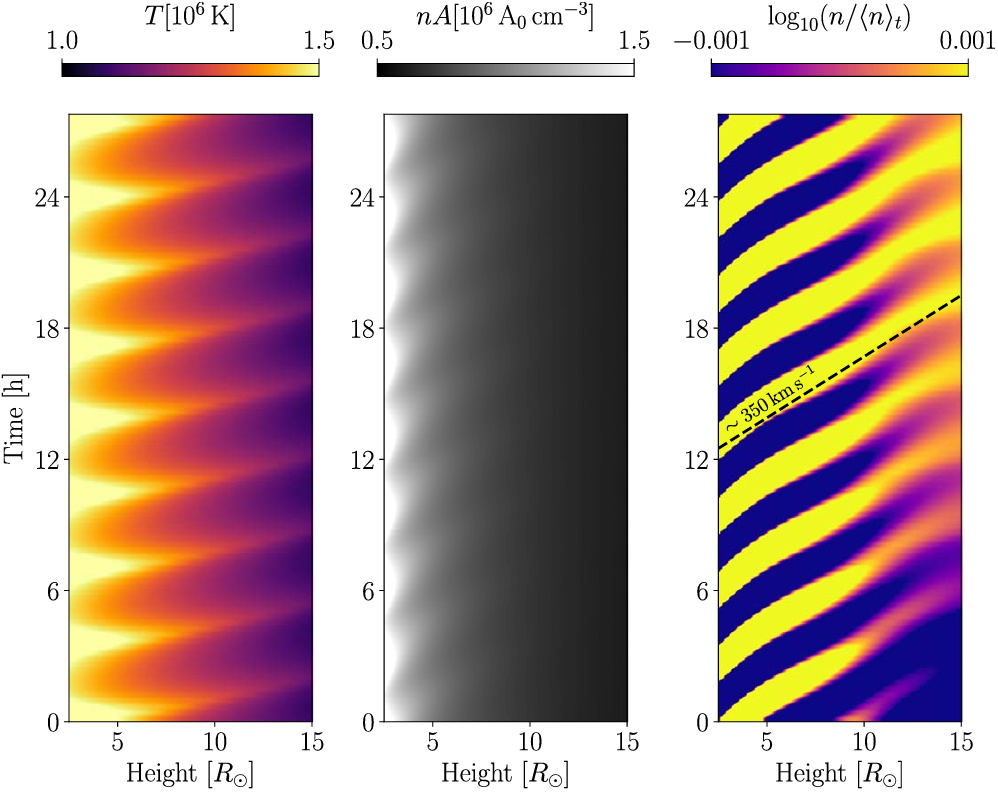
The solar wind is commonly divided between the "fast" and "slow" types, which exhibit distinct signatures in their velocity, density, and temperature profiles, as well as elemental abundances and ionization states. Numerous mechanisms have been proposed to explain the differences between these two classes, including local heating and direct momentum deposition, magnetic field expansion, and even magnetic reconnection. The structure of the coronal magnetic field is thought to be especially important in determining the source region of the slow wind, whose material composition suggests that at least some fraction of the plasma originates within the magnetically closed corona. The Goal of this investigation is to determine the importance of magnetic geometry to the physical processes that drive the solar wind, and fix its material properties, by modeling plasma outflows along the complex magnetic structures that comprise the boundary between open and closed coronal domains. We answer three Science Questions: 1. How do field-aligned solar wind profiles depend on flux-tube geometries that (a) are static in time, (b) evolve smoothly, or (c) evolve discontinuously, as dictated by interchange reconnection? 2. What is the spatial and temporal relationship between topological features in coronal magnetic fields and boundary layers in the evolving coronal plasma? 3. What signatures in the ionization state of solar wind plasmas can be expected to result from variations in static and dynamic magnetic geometries?
Related Publications
- Simulation of Thermal Nonequilibrium Cycles in the Solar Wind
- The Dynamic Evolution of Solar Wind Streams Following Interchange Reconnection
- A Reconnection-driven Rarefaction Wave Model for Coronal Outflows
 Turbulence in the Active Sun
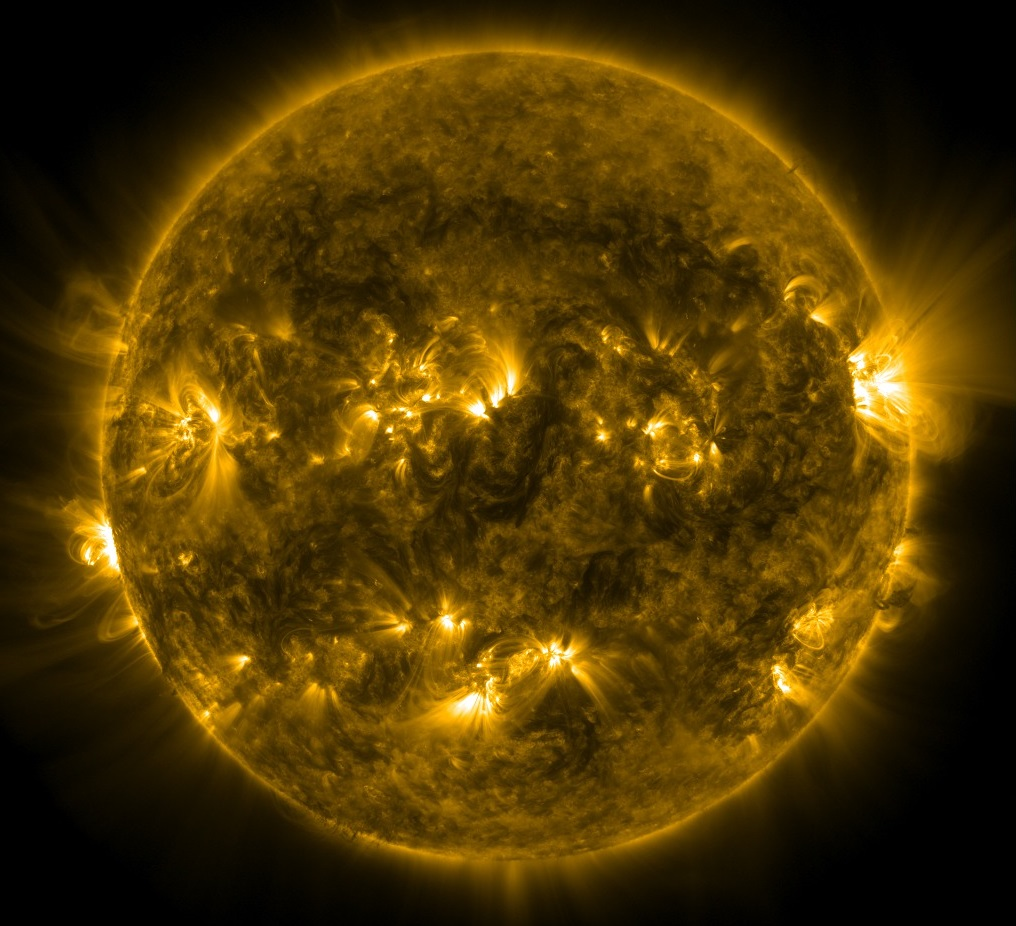
It is expected that turbulence plays a key role in mediating the release and transport of energy in the solar atmosphere. Hot spectral lines observed during flares have widths that exceed the thermal width and such broadening is strong evidence for turbulent flows. Observations have shown turbulent regions near the primary site of flare energization that can play a major role in energy transport away from it. Turbulence modifies the classical plasma transport coefficients and thus particle momentum and energy fluxes. Modeling has shown that the energy deposition by accelerated electrons propagating in a turbulent medium has a diffusional form that is different to a “test particle” model, and that suppression of heat conduction by turbulence can help explain the long post-flare loop cooling times. These processes have important consequences for the response of the atmosphere to flare energy input. The Goal of this investigation is to determine the strength of turbulence in different regions and conditions in the active solar atmosphere, predict the effect of turbulence on energy transport, and build this physics into numerical models for a self-consistent description and understanding of energy transport and atmospheric response in a turbulent environment. We answer two Science Questions: 1. What is the strength and vertical stratification of turbulence in the solar atmosphere? 2. How does turbulence affect the energetic coupling between the lower and upper solar atmosphere?
Related Publications
- Temperature and Differential Emission Measure Profiles in Turbulent Solar Active Region Loops
- Scaling Laws for Dynamic Solar Loops
- Coronal Loop Scaling Laws for Various Forms of Parallel Heat Conduction
 Modeling Signatures of Plasma Energization by Interchange Reconnection in the Solar Corona: A Multi-species Fluid Approach
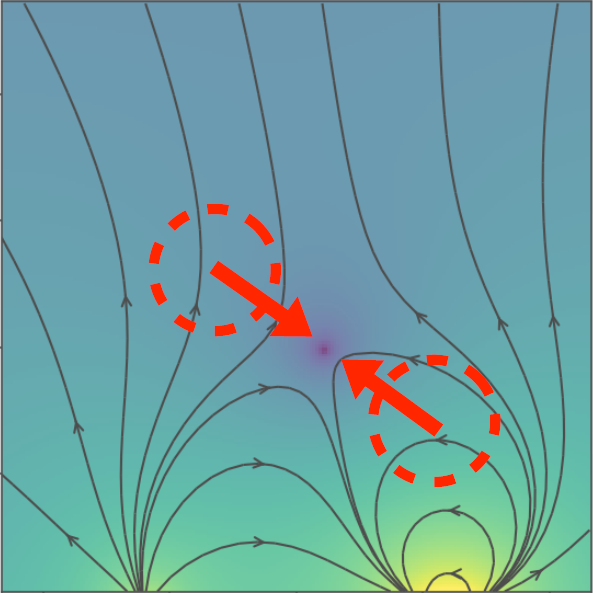
The Sun’s corona is the source of space weather throughout our solar system. Magnetic reconnection is a crucial component of coronal dynamics, where plasma is rapidly energized by a restructuring of the magnetic field. Interchange reconnection is a reconnection scenario occurring between separate regions of closed and open magnetic field in the corona, resulting in an “interchange" of plasma between neighboring regions that were previously isolated. Interchange reconnection at the edge of an active region injects high pressure plasma into the open-field region, forming a sharp discontinuity which evolves into a shock in the newly-reconnected flux tube and propagates out into the heliosphere. Interchange reconnection inserts time-dependent signatures into the outflowing solar wind that are encoded in the properties of particle species and ionization states. In-situ measurements, remote observations, and sophisticated numerical models can then be combined to diagnose the properties of the mechanism that heats and accelerates the solar wind at the Sun. The asymmetry of the reconnecting field structure suggests an important link to space weather-related phenomena observed in the corona and solar wind. The Goal of this investigation is to determine the properties of interchange reconnection at active region boundaries and What it contributes to the evolution of the solar wind into the heliosphere. We answer two Science Questions: 1. How are solar wind and spectral signatures resulting from interchange reconnection impacted by cross-species collisional equilibration, non-equilibrium ionization, and plasma non-neutrality? 2. What effect does multi-dimensionality have on post-interchange reconnection dynamics, compared with field-aligned modeling?
Related Publications